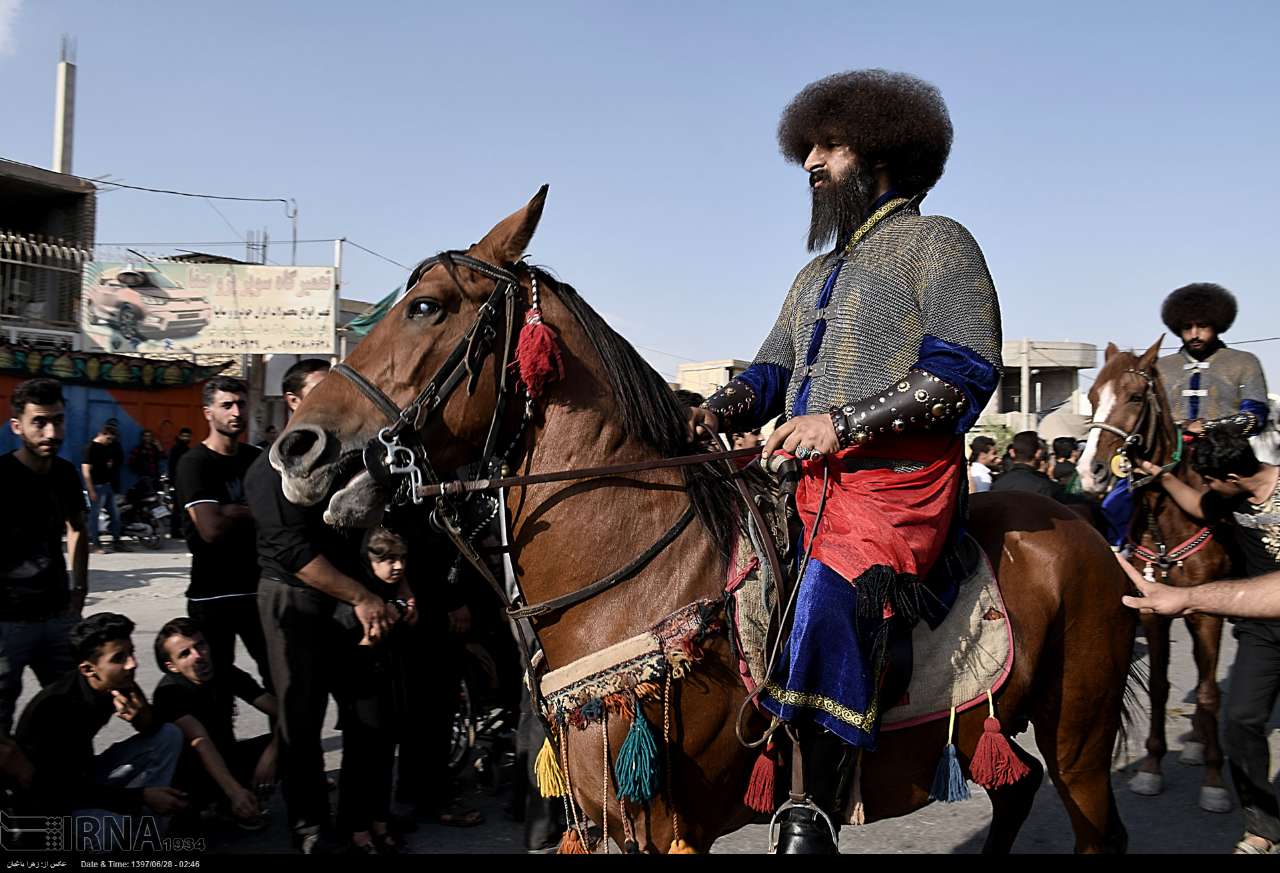
[custom_adv] Al-Ḥusayn ibn Ali ibn Abi Talib was a grandson of the Islamic prophet, Muhammad, and son of Ali ibn Abi Talib (the first Shia Imam and the fourth Rashid caliph of Sunni Islam) and Muhammad's daughter, Fatimah. [custom_adv] He is an important figure in Islam as he was a member of the Bayṫ of Muhammad and the Ahl al-Kisā' , as well as the third Shia Imam.Prior to his death, the Umayyad ruler Muawiya appointed his son Yazid as his successor in a clear violation of the Hasan-Muawiya treaty. [custom_adv] When Muawiya died in 680 CE, Yazid demanded that Husain pledge allegiance to him. Husain was well-known as the grandson of Muhammad and was an exemplary Muslim; if Husain pledged allegiance to Yazid, who was corrupt, shameless, and tyrannical, it would be seen as legitimizing Yazid's behavior in Islam. [custom_adv] Thus, in order to save Islam from Yazid's influence, Husain refused to pledge allegiance to Yazid, even though it meant sacrificing his life. As a consequence, he left Medina, his hometown, to take refuge in Mecca in AH 60. [custom_adv] There, the people of Kufah sent letters to him, asking his help and pledging their allegiance to him. So he traveled towards Kufah; however, at a place near it known as Karbala, his caravan was intercepted by Yazid's army. [custom_adv] He was killed and beheaded in the Battle of Karbala on 10 October 680 (the 10th of Muharram in 61 AH) by Shimr ibn Thil-Jawshan, along with most of his family and companions, including Husayn's six month old son, Ali al-Asghar, with the women and children taken as prisoners. [custom_adv] Anger at Husayn's death was turned into a rallying cry that helped undermine the Umayyad caliphate's legitimacy, and ultimately overthrow it by the Abbasid Revolution. [custom_adv] Husayn is highly regarded by Shia Muslims for refusing to pledge allegiance to Yazid, the Umayyad caliph, because he considered the rule of the Umayyads unjust. The annual memorial for him and his children, family and his companions is the first month in the Islamic calendar, that is Muharram, and the day he was martyred is known as Ashura (the tenth day of Muharram, a day of mourning for Shi'i Muslims). [custom_adv] His action at Karbala fueled the later Shia movements. The martyrdom of Husayn was decisive in shaping Islamic and Shia history. The timing of the Imam's life and martyrdom were crucial as they were in one of the most challenging periods of the 7th century. [custom_adv] During this time, Umayyad oppression was rampant, and the stand the Imam and his followers took became a symbol of resistance inspiring future uprisings against oppressors. [custom_adv] Main articles: Family tree of Husayn ibn Ali and Daughters of Husayn ibn Ali Husayn's maternal grandmother was Khadijah bint Khuwaylid, and his paternal grandparents were Abu Talib and Fatimah bint Asad. [custom_adv] Husayn and Hasan were regarded by Muhammad as his own sons due to his love for them and as they were the sons of his daughter Fatima and he regarded her children as his own children and descendants. [custom_adv] He said "Every mother's children are associated with their father except for the children of Fatimah for I am their father and lineage" Thus descendants of Fatimah are descendants of Muhammad, and part of his Bayt. [custom_adv] Husayn was born on 10 October CE 625 (3 Sha'aban AH 4).However, Shia Hadith state that He was born AH .Husayn and his brother Hasan were the last descendants of Muhammad living during his lifetime and remaining after his death. [custom_adv] According to the Shi'ah, Husayn was the third Imam for a period of ten years after the death of his brother Hasan in CE 669, all of this time but the last six months coinciding with the caliphate of Mu'awiyah. [custom_adv] After the peace treaty with Hasan, Mu'awiyah set out with his troops to Kufa, where at a public surrender ceremony Hasan rose and reminded the people that he and Husayn were the only grandsons of Muhammad, and that he had surrendered the reign to Mu'awiyah in the best interest of the community: "O people, surely it was God who led you by the first of us and Who has spared you bloodshed by the last of us. [custom_adv] I have made peace with Mu'awiyah, and I know not whether haply this be not for your trial, and that ye may enjoy yourselves for a time." declared Hasan.In the nine-year period between Hasan's abdication in 41/660 and his death in 49/669, Hasan and Husayn retired in Medina trying to keep aloof from political involvement for or against Muawiyah. [custom_adv] Shia feelings, however, though not visible above the surface, occasionally emerged in the form of small groups, mostly from Kufa, visiting Hasan and Husayn asking them to be their leaders - a request to which they declined to respond. Even ten years later, after the death of Hasan, when Iraqis turned to his younger brother, Husayn, concerning an uprising, Husayn instructed them to wait as long as Muawiyah was alive due to Hasan's peace treaty with him.