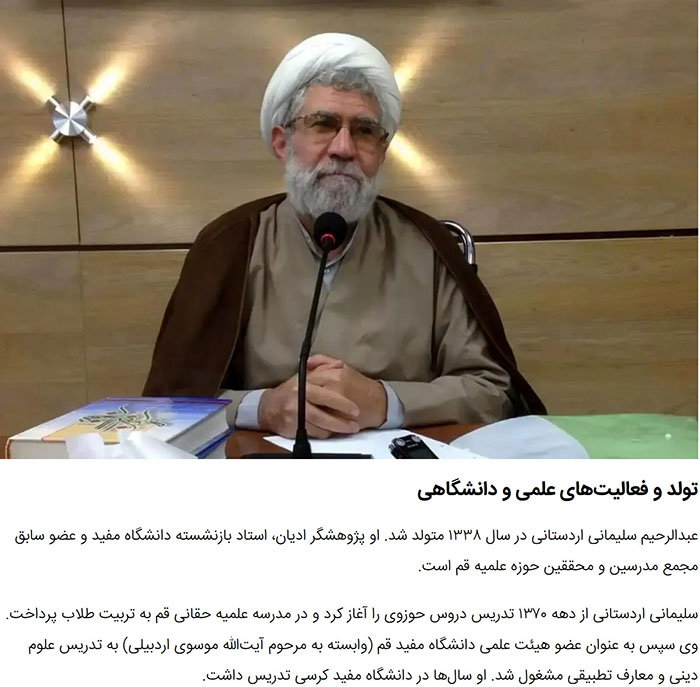
Abdul Rahim Soleimani Ardestani, born in 1953, is one of the contemporary Iranian clerics whose intellectual path has been tied to religious studies, comparative theology, and research on the Abrahamic traditions. A long-time professor at Mufid University in Qom and a member of the Assembly of Teachers and Researchers of the Qom Seminary, he is known both for his scholarly contributions and for controversial positions that have repeatedly brought him to the center of public and political debates. His life story intertwines academic dedication, reformist religious thought, political friction, and public criticism.
Birth, Early Life, and Education
Soleimani Ardestani was born in Ardestan, a historic town in Isfahan province. Born into a generation shaped by the socio-political changes of mid-20th-century Iran, his early education was influenced by both traditional religious schooling and the cultural atmosphere of a society in transition. Like many clerics of his generation, he pursued seminary education at a young age, eventually migrating to Qom—the religious center of modern Shiism.
During the 1970s and early 1980s, he completed advanced seminary courses, studying jurisprudence, principles of jurisprudence, theology, and Qur’anic exegesis under prominent teachers of the Qom Seminary. These decades were formative for him; theological debates, political events, and the changing intellectual climate of the seminary helped shape the foundations of the analytical approach he adopted later in life.