This affiliation positioned him within the broader reformist movement that emerged in the late 1990s during the presidency of Mohammad Khatami. Through this association, he became publicly linked with reformist political thought, pluralistic religious interpretation, and support for institutional change.
Arrest in 2009 After the Presidential Elections
Following the disputed 2009 Iranian presidential elections, protests erupted across the country. During a protest ceremony at Behesht-e-Zahra cemetery in Tehran, Soleimani Ardestani was arrested by law enforcement forces.
His arrest was part of a larger crackdown on clerics, students, activists, and professors who were perceived to support the protest movement. Although he was not among the main political activists, his involvement in the protest event and his reformist affiliation led to his detention. He was released several months later, in September 2009.
Recurring Media Attacks
Conservative media outlets, including Rajanews, repeatedly referenced his arrest in subsequent years. He was frequently described as one of the “elements of the 2009 sedition,” a label used to refer to individuals associated with the Green Movement.
In 2011, when a group of clerics met with Ayatollah Hashemi Rafsanjani, Rajanews again highlighted Soleimani Ardestani as “an active figure in the post-2009 election riots,” using his name to criticize reformist clerical networks.
These recurring references solidified his image as a cleric intellectually aligned with reformism and politically distanced from conservative institutions.
Recent Controversy: Statements About the Death of Hazrat Fatima Zahra
The Online Discussion and Initial Reaction
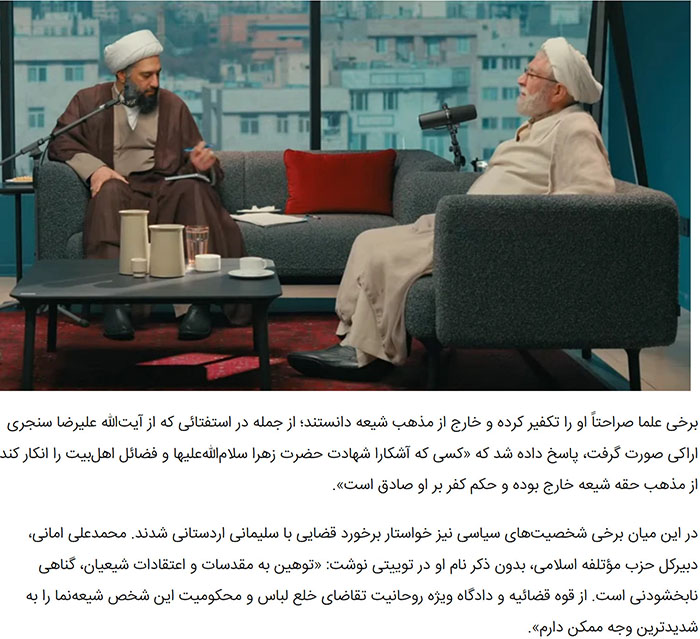
In 1404, Soleimani Ardestani became the subject of intense controversy due to comments he made during an online program called “Azad.” In this discussion, he questioned the traditional Shiite narrative regarding the death of Hazrat Fatima Zahra (PBUH), the daughter of the Prophet Muhammad.
While his intention appeared to be academic or historical critique, the comments ignited a wave of backlash. Seminary scholars, political activists, and religious followers reacted strongly, accusing him of undermining core Shiite beliefs.