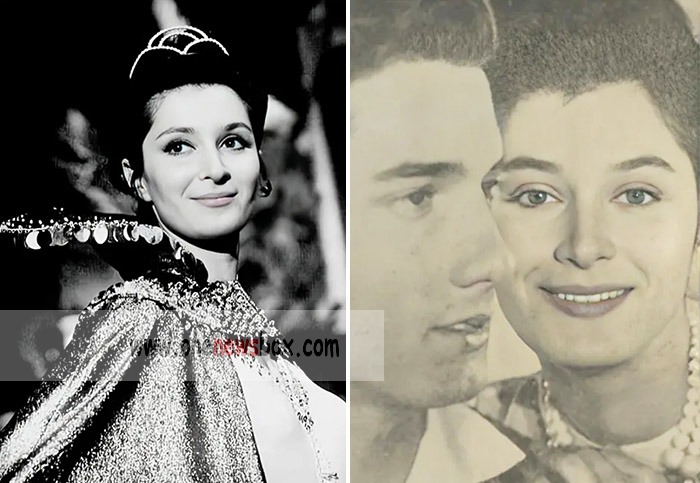
Giti Darogar herself addressed her origins in a short autobiographical text published on her personal website in German. In this biography, she confirms that she was born in Tehran to an Iranian industrialist father and a German mother, growing up in a household shaped by both Iranian traditions and European cultural influences.
This bicultural upbringing was not merely a background detail; it formed the foundation of her later artistic trajectory. From an early age, Giti was exposed to different languages, aesthetic sensibilities, and social norms. In the context of mid-20th-century Iran—where women’s access to international education and artistic careers was still limited—this background provided her with unique opportunities.
Interestingly, the Darogar company itself reflected this blend of personal and commercial identity. In 1953, the company launched a perfume named “Giti”, a gesture that suggests both familial pride and an awareness of the symbolic value attached to her name. Whether intended as a tribute or a marketing decision, the perfume stands as a rare instance where Giti’s presence intersected visibly with the industrial empire founded by her father.
After completing her adolescence in Iran, Giti Darogar left the country and embarked on an educational journey that took her across Europe. According to her own account, she first traveled to Germany, then to Britain and Switzerland, before finally settling for a time in France. This trajectory mirrors that of many postwar European intellectuals and artists, moving between cultural centers in search of education and artistic refinement.
In France, she studied at the School of Fine Arts in Nice, immersing herself in visual arts and classical aesthetics. She later enrolled in the Dramatic Academy of Berlin, where she received formal training in acting. During this period, she also attended the Grand Conservatory in Germany, further refining her skills in performance and stage presence.
Her talent did not go unnoticed. After appearing in several theatrical productions, she attracted the attention of prominent German filmmakers, including Kurt Hoffmann, one of the leading figures in postwar German cinema. Hoffmann cast her in one of his films, marking her official entry into professional acting and setting the stage for her international breakthrough.
In the heart of Tehran, even as the shadow of the 2026 conflict between Iran, …