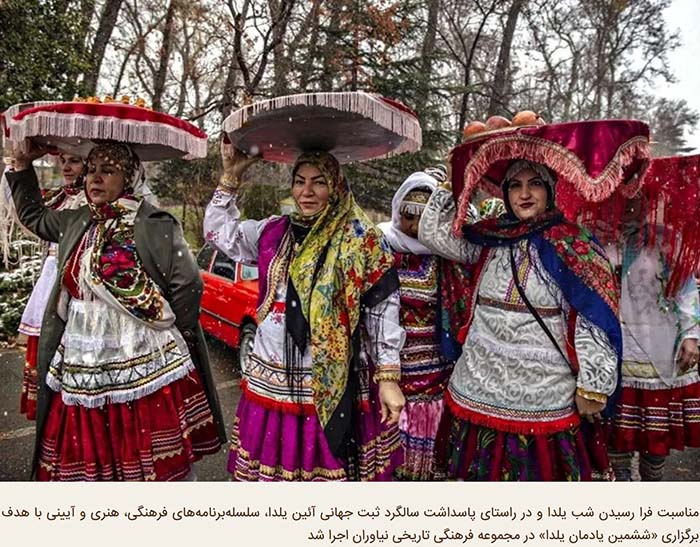
On the Occasion of the Sixth Yalda Memorial at the Niavaran Cultural and Historical Complex
On the occasion of Yalda Night and in commemoration of the anniversary of the international registration of the Yalda ritual, a series of cultural, artistic, and ritual programs were held at the Niavaran Cultural and Historical Complex under the title of the “Sixth Yalda Memorial.” This event aimed not only to celebrate one of the most ancient Iranian traditions but also to emphasize its enduring role in shaping cultural identity, social cohesion, and intergenerational continuity in Iranian society.
Yalda Night—also known as Shab-e Yalda, Shab-e Chele, or Chele-ye Bozorg (the Great Chele)—is among the oldest known Iranian celebrations, observed annually on the longest night of the year. This night coincides with the winter solstice, marking the transition from autumn to winter and symbolizing the gradual victory of light over darkness. The ceremony begins at sunset on Azar 30 and continues until sunrise on Dey 1, when families and communities gather to celebrate, converse, remember, and hope.
Yalda as a Cosmic and Seasonal Turning Point
Astronomically, Yalda corresponds to the winter solstice in the Northern Hemisphere, when the Earth reaches a position in its orbit where the night is at its longest and the day at its shortest. From this point onward, days gradually lengthen, and nights shorten. For ancient civilizations, deeply connected to nature and celestial cycles, this moment held profound symbolic meaning.