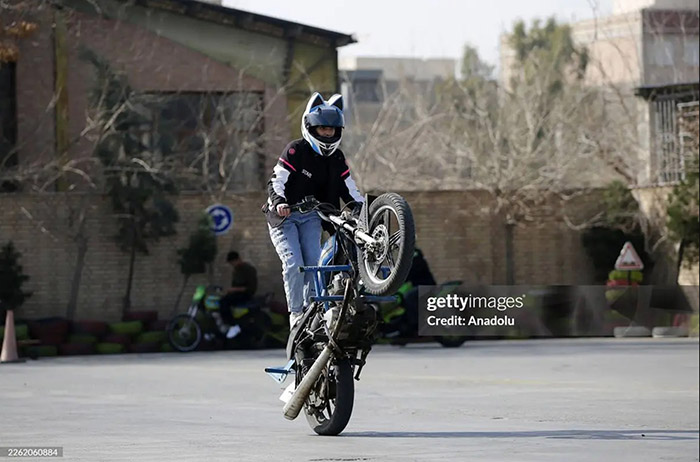
Despite this legal reading, the reality over the past two decades has been more complicated. For approximately twenty to twenty-five years, authorities refrained from issuing motorcycle licenses to women. Mehmandar described these reasons as non-technical, suggesting that they stemmed more from custom or administrative interpretation than from binding legislation. This gap between written law and administrative practice became the focal point of the controversy.
He noted that at one point lawmakers specified that the responsibility for issuing certain licenses rested with the police in relation to men. However, the legislation did not clearly articulate the status of women. In his view, this silence created ambiguity. A law that explicitly mentions one group while omitting another risks being interpreted in ways that were not necessarily intended. He suggested that such drafting flaws may have contributed to the longstanding hesitation in granting licenses to women.
The broader discussion extended beyond technical legalities to questions of social impact. Some critics raised concerns about safety, arguing that motorcycles are inherently riskier than cars and that expanding access could increase accident rates. Mehmandar responded by emphasizing that risk is not gender-specific. Speeding, dangerous overtaking, and reckless maneuvers are behaviors that can be committed by any individual. The purpose of traffic laws, violation tables, and enforcement mechanisms is precisely to address such conduct regardless of who commits it.