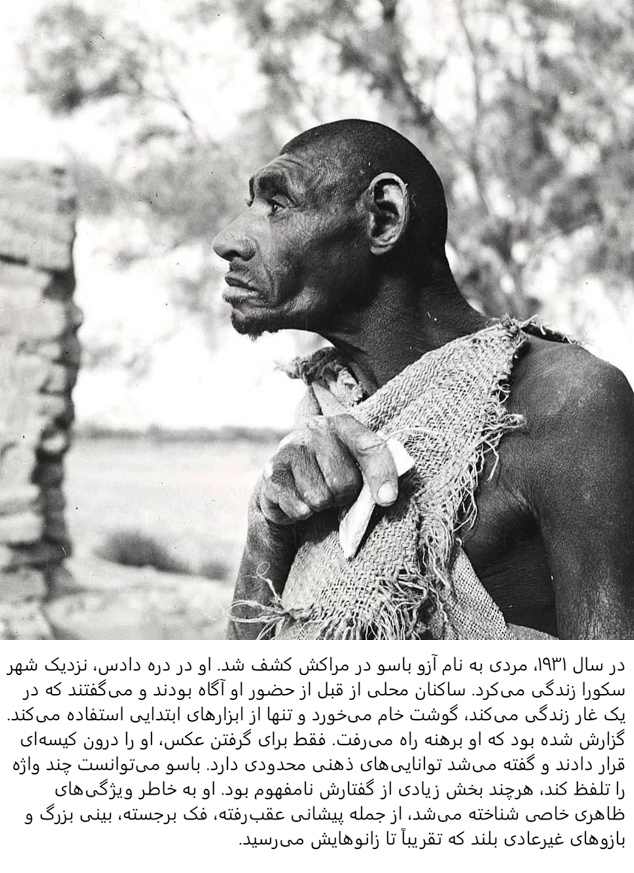
In 1931, a man named Azzo Bassou was discovered in Morocco. He lived in the Dades Valley, near the town of Skoura. Local residents were already aware of his presence and said he lived in a cave, consumed raw meat, and used only rudimentary tools. He reportedly walked naked – he was placed in a bag solely for the purpose of photographing him – and was described as having limited intellectual abilities.
Bassou could pronounce a few words, though much of his speech was unclear. He was noted for distinctive physical features, including a receding forehead, a protruding jaw, a large nose, and unusually long arms that nearly reached his knees. In 1956, French writer Jean Boulet, accompanied by ethnologist Marcel Gomet, traveled to the region to investigate and document the case. Some scientists who examined him compared his skull to Neanderthal remains and were struck by certain similarities. Sensationalist tabloids quickly labeled him “the missing link,” portraying him as the last living Neanderthal.