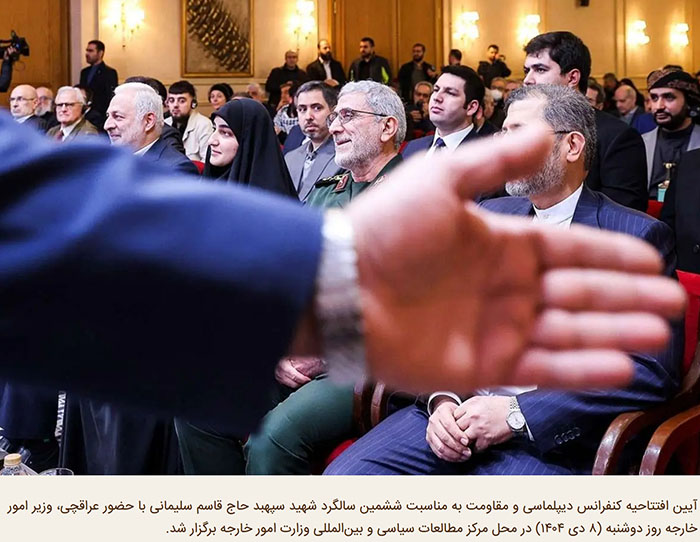
On Monday, January 27, 2021, the opening ceremony of the Diplomacy and Resistance Conference was held at the Center for Political and International Studies (IPIS) of Iran’s Ministry of Foreign Affairs. The event coincided with the sixth anniversary of the martyrdom of Lieutenant General Hajj Qassem Soleimani, the former commander of the Quds Force of the Islamic Revolutionary Guard Corps (IRGC), whose assassination in January 2020 marked one of the most consequential turning points in the contemporary political and security history of the Middle East.
The ceremony was attended by senior diplomats, political analysts, academics, researchers, and representatives of various Iranian institutions. Among the prominent figures present was Abbas Araqchi, a senior Iranian diplomat and high-ranking official at the Ministry of Foreign Affairs, whose participation underscored the central theme of the conference: the intersection of resistance as a strategic doctrine and diplomacy as a political instrument in Iran’s regional and international outlook.
The conference sought not only to commemorate Soleimani as a military commander but also to examine his broader legacy as a figure whose actions reshaped Iran’s understanding of diplomacy, regional alliances, and asymmetric power. By framing the discussion around “Diplomacy and Resistance,” the organizers emphasized that Soleimani’s role transcended the battlefield and extended into the political architecture of regional resistance networks.