By the mid-1950s, Mohammad Reza Shah Pahlavi had emerged from the most dangerous crisis of his reign with a renewed sense of authority and historical purpose. The overthrow of Prime Minister Mohammad Mossadegh in 1953, engineered with the decisive involvement of British and American intelligence services, marked a turning point not only in Iran’s political trajectory but also in the …
Read More »History
Reza Shah and Mohammad Reza Pahlavi visit Bushehr Port
Reza Shah Pahlavi (15 March 1878 – 26 July 1944), born Reza Khan, was one of the most consequential figures in modern Iranian history. Rising from humble origins as a military officer to become Shah of Iran, he founded the Pahlavi dynasty and ruled the country from 1925 until 1941. His reign marked a decisive break with Iran’s pre-modern political …
Read More »Spectacular photos of Tehran’s beggars’ camp
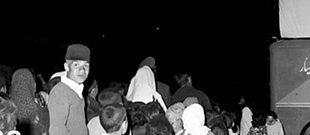
Fifty years ago, in a period when Tehran was undergoing rapid urban growth and social transformation, municipal institutions launched an unusual and, for its time, innovative initiative: a training camp for beggars. The idea behind this program was not merely to remove beggars from the streets temporarily, but to address what officials perceived as the root causes of begging by …
Read More »Maryam Roohparovar, known as Umm Kulthum of Iran
Maryam Roohparovar (September 31, 1932 – January 1, 1987) was one of the most powerful and emotionally resonant voices of Iranian popular music in the 1960s. Though her name may not be as widely remembered as some of her contemporaries, Roohparovar occupies a unique and influential place in the history of Iranian vocal performance. Her life and career reflect the …
Read More »Equipping Tehran police cars with American-made transceivers in the late 1930s
The late 1930s marked a decisive chapter in the transformation of Iran from a fragmented, semi-traditional society into a centralized modern state. Under the rule of Reza Shah Pahlavi, modernization was pursued not as a gradual cultural evolution but as a forceful, state-driven project. Roads, railways, schools, courts, and military institutions were reorganized to reflect a new vision of order, …
Read More »“Khalil Oqab” surprised people at the officer academy!
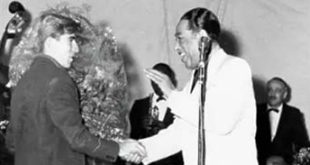
On December 17, 1955, the Officers’ Club in Tehran hosted a performance unlike anything the city had witnessed before. The main attraction was a young man named Khalil Tarighat Pima, better known to the public as Khalil Oqab. At just 28 years old, he had already begun to attract attention through extraordinary demonstrations of physical power, endurance, and courage. That …
Read More »Hollywood star eating Chelo Kebab in Tehran
Yul Brynner (Russian: Юлий Борисович Бринер), born July 11, 1920, and deceased October 10, 1985, stands as one of the most distinctive and enduring figures of twentieth-century stage and film acting. Known worldwide for his commanding presence, resonant voice, and unmistakable shaved head, Brynner forged a career that bridged Broadway and Hollywood at a time when both industries were undergoing …
Read More »Tehran Slaughterhouse turns 70!
The early 1950s marked a decisive turning point in the history of Tehran’s urban development. As Iran’s capital expanded rapidly in population, geography, and economic complexity, the shortcomings of traditional urban infrastructure became increasingly visible. Among the most pressing challenges was the issue of food supply—particularly meat production and distribution—which directly affected public health, municipal order, and the daily lives …
Read More »Giti Darogar, the first Iranian actress in Hollywood
Giti Darogar (Giti Jamal): A Forgotten Iranian Name in the Early History of Global Cinema Few names in the long and winding history of cinema are as obscure, and at the same time as astonishing, as that of Giti Darogar, also known in international artistic circles as Giti Jamal. Her story stands at the intersection of Iranian industrial modernity, European …
Read More »Rarely seen photos of the mother of Iranian cinema
Hamideh Khairabadi (December 20, 1924 – April 2010), universally known by her artistic name Nadereh, occupies a singular and irreplaceable position in the history of Iranian performing arts. With a career spanning more than five decades across theater, cinema, and television, Khairabadi became one of the most recognizable faces of Iranian visual culture. She is widely remembered and honored as …
Read More »