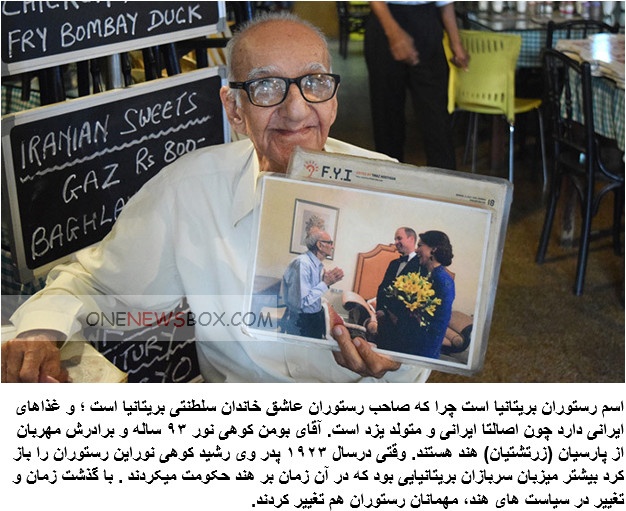
[custom_adv] 96 years since, it continues to capture the hearts of all those who walk into it. The guests are fed mouth-watering dishes, with a side of pre-independence stories and humorous anecdotes by its owner, Boman. [custom_adv] Boman took over the operations at the tender age of 16 after his father passed away in an accident in 1939. Today, he continues to run it with the help of his children, the third generation of the Kohinoor family. [custom_adv] In the nine decades of existence, the café has come a long way from catering to the spice-intolerant British officials stationed in the Fort area. It adapted several dishes to suit the Indian palate and today, one can also find spicy Parsi and Mughlai food in the menu. [custom_adv] However, through the years, the ambience hasn’t changed. It runs for four hours a day except on Sundays, when it stays shut, and the Bentwood furniture imported from Poland during Boman’s father’s time is still around.While it was originally known for its continental food, some of the bestsellers were introduced by Bachan Kohinoor, Boman’s late wife. [custom_adv] A legal adviser, she was posted in Iran for several years, while Boman ran Britannia in India. When she retired, she moved back to the city and introduced dishes like the classic berry pulao, chicken dhansak, sali boti, patra ni macchi and caramel custard in the restaurant. [custom_adv] This is the café’s signature dish, and comprises flavourful chicken cooked with the right balance of spices, tomatoes, served with aromatic and fluffy basmati rice, topped with barberries, crispy fried shallots, cashews, and caramelised onions. [custom_adv] Bachan had introduced some variations on the dry persian berry pulao, by adding spices and more gravy to the recipe. Also, the zereshk berries used in the dish are reportedly imported from Iran. [custom_adv] Topped with shoe-string fried potatoes, this classic Parsi dish with a reddish-brown gravy and tender mutton that falls apart in your mouth with every bite is a must-try.In an interview with CNN travel, Boman adds how non-Indian patrons love to pack packets of berry pulao to take abroad, while Indian patrons choose the more traditional patra ni macchi and dhansak. [custom_adv] He tells us about a Singaporean lady who has been taking large orders of sali boti and dhansak for more than ten years, while an aged Parsi doctor picks up ten orders of patra ni macchi to London every six months. Freezing them, he treats himself to the Parsi meal over days. [custom_adv] The man requested an Air-India air hostess who regularly flew from the Mumbai-London sector to take 100 chapatis from the café every week for him. Packed in air-tight containers, these chapatis made their way to Heathrow every week for seven months until it stopped.