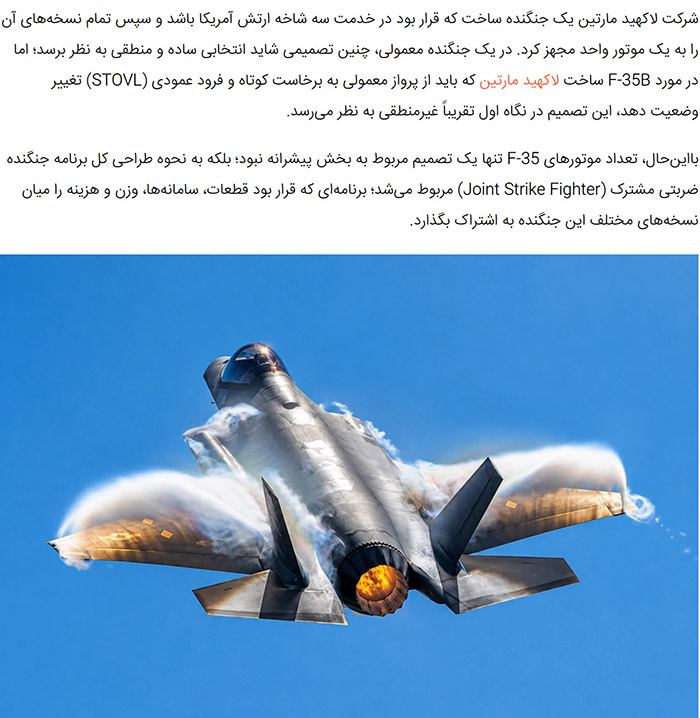
Lockheed Martin’s F-35 Lightning II represents one of the most ambitious attempts ever made to develop a family of combat aircraft around a common design philosophy. Although the aircraft exists in three distinct versions, the F-35A, F-35B, and F-35C were conceived as members of the same family rather than as three unrelated fighters. Each version was designed to satisfy the requirements of a different branch of the U.S. military, yet all three share a remarkable amount of technology, avionics, software, structure, and propulsion architecture.
At the center of that commonality is an unusual decision: all three variants use a single engine.
For the conventional F-35A operated by the U.S. Air Force, a single-engine configuration may appear relatively straightforward. The F-35C, designed for aircraft-carrier operations by the U.S. Navy, presents greater structural and aerodynamic challenges, but it too relies on a conventional single-engine arrangement. The most difficult case is the F-35B, developed primarily for the U.S. Marine Corps.
Unlike its siblings, the F-35B must be capable of Short Take-Off and Vertical Landing, or STOVL. This means the aircraft must not only generate sufficient thrust for high-speed conventional flight but must also redirect that propulsion system to produce lift during hovering and vertical landing operations.
At first glance, using a single engine for such an aircraft might seem almost counterintuitive. A conventional fighter engine produces thrust by accelerating air and exhaust rearward. A STOVL aircraft, however, needs to produce a substantial amount of downward force while maintaining control over the aircraft in a highly demanding flight regime.