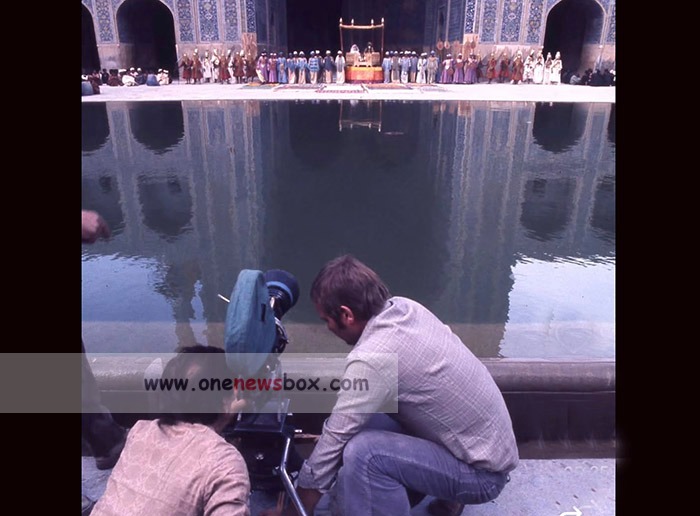
But Pasolini’s relationship with Iran cannot be reduced to aesthetic appreciation. His journey was also an encounter with a society that he could not completely control or understand. This is an essential part of the story.
Filmmakers often imagine that a location is something they can enter, use, and leave. Pasolini’s experience reminds us that locations are not empty stages. They belong to people. They carry religious meanings, memories, customs, and rules. A building that appears to a filmmaker as a magnificent architectural setting may have a completely different significance to those who live around it.
A mosque is the clearest example. To a filmmaker looking for a beautiful setting for an ancient story, its arches, tiles, courtyards, and light might seem visually perfect. To believers, however, it is a sacred space. An intimate scene within such a place can therefore be understood not simply as a cinematic action but as a violation of the meaning of the space itself.
The conflict in Isfahan reveals the limits of Pasolini’s artistic freedom. His cinema was deliberately provocative, and he was accustomed to confronting conventional morality. But cultural provocation becomes something different when it crosses into a world whose codes one does not fully share.
And yet, there is something compelling in the idea that Pasolini gradually learned from the encounter.