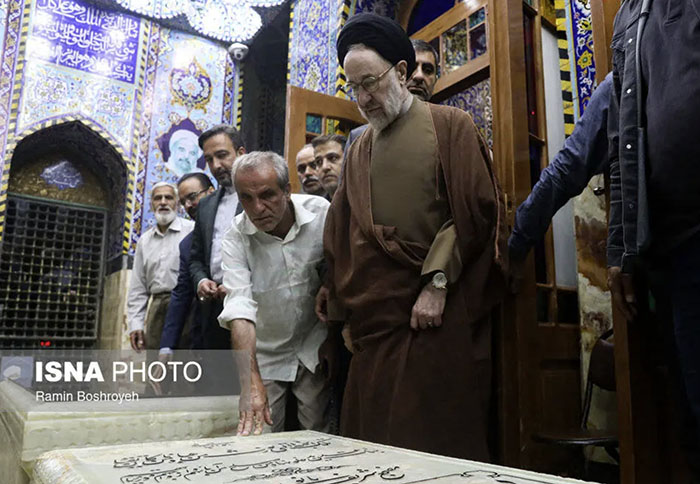
The funeral ceremony for Sayyida Hajiya Khadija Khatami therefore resonated emotionally with many individuals who continue to identify with the reformist movement and the historical legacy associated with Mohammad Khatami’s presidency.
Iranian social media platforms and news outlets circulated numerous images from the ceremony showing mourners gathered at the mosque in Yazd. Public reactions online included condolences, reflections on the Khatami family’s role in Iranian society, and memories connected to the reform era of the late 1990s and early 2000s.
Many users described Mohammad Khatami as one of the most influential political personalities of modern Iran, while others focused on the family’s religious and cultural contributions within Yazd Province. The emotional responses demonstrated how strongly the Khatami name continues to resonate across different segments of Iranian society.
In Iran’s political culture, family reputation and religious lineage often remain highly important. Clerical families with longstanding community influence frequently become associated not only with religion but also with education, social leadership, and political identity. The Khatami family represents one of the most visible examples of this tradition in contemporary Iran.
The ceremony also highlighted the continuing relevance of reformist political networks inside Iran. Although reformist politicians have faced political limitations in recent years, public gatherings connected to influential reformist figures still attract considerable attention and participation. Funeral ceremonies, memorial events, and religious gatherings often become spaces where political solidarity and historical continuity are quietly expressed.