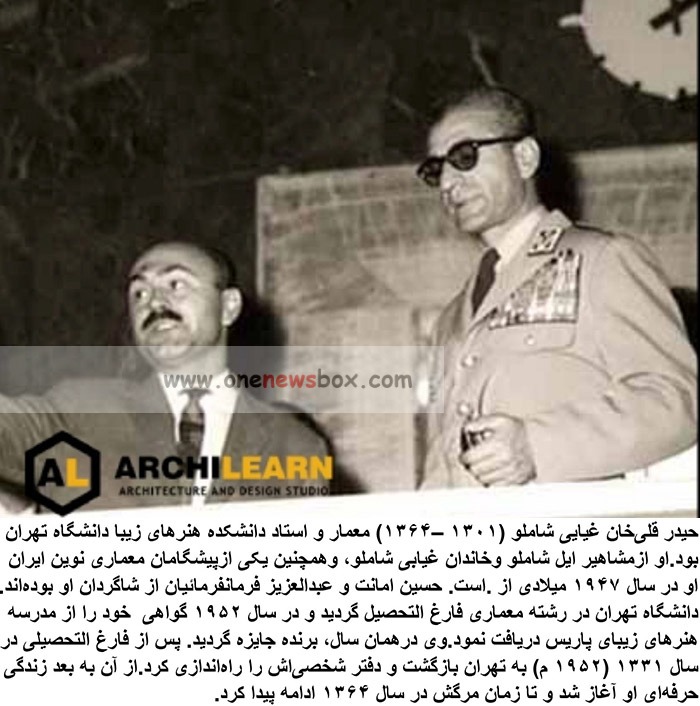
Heydar Gholi Khan Ghiaei Shamloo, also known as Heydar Ghiaei, was one of the most influential architects of modern Iran. Born on October 20, 1922, in Capital and dying in southern France in 1985, Ghiaei belonged to a prominent and wealthy family and emerged during a period when Persian architecture was undergoing a profound transformation. His career coincided with the rapid modernization of Iran in the mid-twentieth century, a period in which traditional architectural practices increasingly encountered modernist ideas arriving from Europe. Through his buildings, teaching, professional activities, and connections with influential political and cultural figures, Ghiaei became an important participant in the formation of modern architectural culture in Iran.
Ghiaei is particularly remembered for his contribution to the development of modernist architecture in Tehran and other Iranian cities. His work included public buildings, hotels, cinemas, railway stations, hospitals, residences, banks, and royal projects. Among his best-known works are the Iranian Senate building, designed in collaboration with Mohsen Foroughi, the Hilton C Hotel, the Moulin Rouge Cinema, Radiocity Cinema, Tabriz Railway Station, Mashhad Railway Station, and several other significant buildings. His architecture was generally characterized by the principles of modernism and the International Style, although some of his later and more distinctive projects demonstrated an interest in sculptural forms and limited forms of architectural localization.