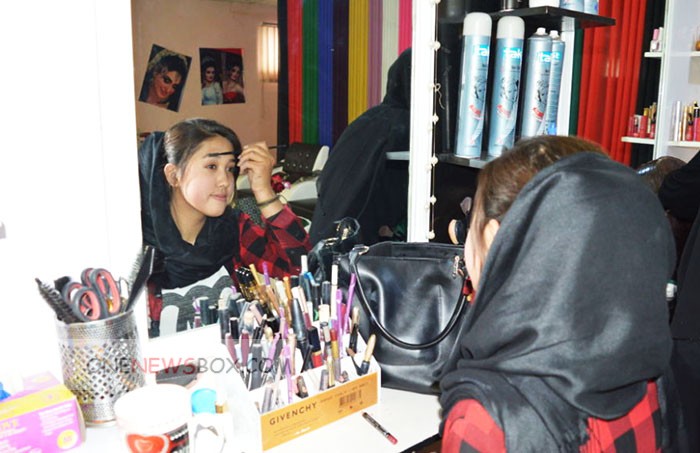
On any given Thursday, salons hum with activity. It’s not unusual to see burqa-covered women alight from cars and duck behind doors plastered with photographs of comely brides. The salons are strictly out of bounds for the prying eyes of Afghan males. Hwo male friends and I had negotiated a visit to photograph Mina, an Afghan woman in her late 30s as she prepared for a wedding she would attend that evening.Mina is a single mother who lives in a ramshackle structure in West Kabul, an area heavily damaged during the civil warfare of the 1990s.
TOn a normal day, she wakes up at 6 a.m., sends her children to school, then catches a crowded minibus that rattles its way to central Kabul. She walks for about 20 minutes along streets shimmering with traffic and dust before arriving at the Shar-i Naw District whose wide roads and semblance of tarmac hint at wealth. Inside, she relaxes at the sight of the pink walls and decorative plastic flowerpots. A little box containing varies shades of rouge lies next to the mirror that reflects Mina’s dress – a revealing, strappy green number studded with golden buttons and mock green emeralds.