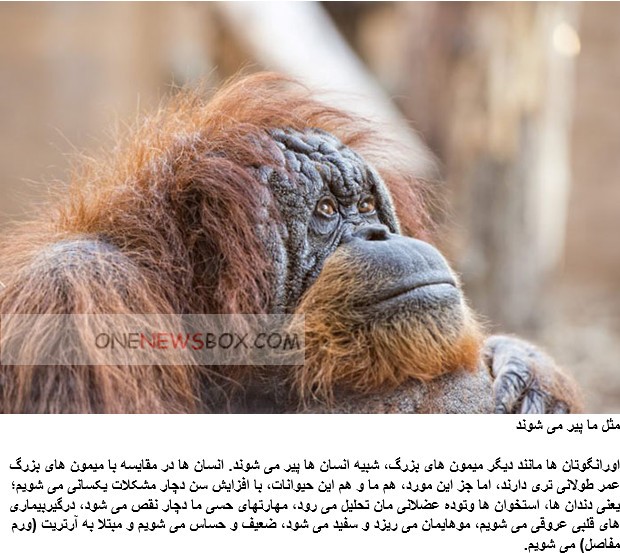
Orangutans, as well as other great apes, age similarly to humans, found researchers publishing in Veterinary Pathology. Humans live longer than all other great apes, but other than that, we all suffer from tooth, bone, and muscle mass loss; sensory impairment; cardiovascular disease; hair loss and graying; frailty; and arthritis, a condition that can take on 100 different forms in humans. Check out the signs of evolution you can still find on your body.
Disclaimer: Orangutans have a very close evolutionary connection to humans. Here’s a clear breakdown: Genetic similarity: Humans share about 97% of our DNA with orangutans, making them one of our closest living relatives (after chimpanzees and bonobos). Evolutionary connection: Orangutans, humans, gorillas, and chimpanzees all belong to the Hominidae family—the “great apes.” Humans and orangutans share a common ancestor that lived roughly 12–16 million years ago. Behavioral similarities: Orangutans are highly intelligent, capable of using tools, solving problems, and even learning aspects of human language when taught in captivity. They have complex social behaviors, though they are more solitary than other great apes.