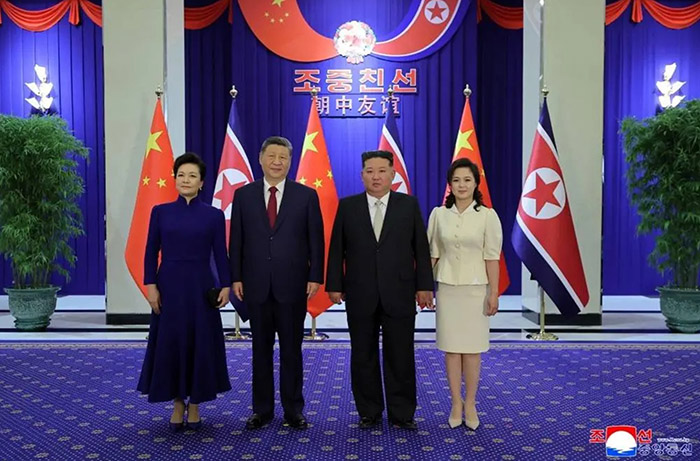
From Beijing’s perspective, the possibility of convincing North Korea to abandon its nuclear arsenal may appear increasingly unrealistic. As a result, Chinese policymakers may be prioritizing stability and strategic cooperation over public pressure regarding denuclearization.
For Kim Jong Un, this development could represent a diplomatic victory. North Korea has long sought international recognition of its status as a nuclear power. While China has not explicitly endorsed North Korea’s nuclear weapons program, reducing emphasis on denuclearization could be interpreted as tacit acceptance of the current reality.
North Korea’s Expanding Nuclear Capabilities
Since Kim Jong Un assumed power in 2011, North Korea has significantly expanded its military capabilities. The country has conducted numerous missile tests, including intercontinental ballistic missiles capable of potentially reaching the United States.
North Korean officials argue that nuclear weapons are essential for national security and regime survival. They point to military exercises conducted by the United States and South Korea as evidence of external threats that justify continued weapons development.
Internationally, North Korea’s nuclear program remains one of the most challenging security issues. The United Nations Security Council has imposed multiple rounds of sanctions aimed at limiting the country’s access to resources and technology. Despite these measures, Pyongyang has continued to advance its capabilities.