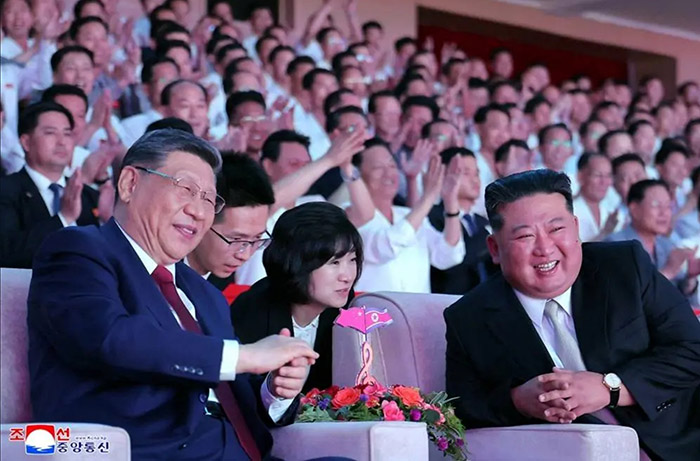
The constitutional amendment adopted in 2023 further reinforced North Korea’s commitment to maintaining and developing nuclear weapons. By embedding nuclear policy into the country’s legal framework, the leadership signaled that nuclear deterrence is now a permanent feature of national strategy.
China’s evolving rhetoric must therefore be understood within this context. Beijing faces the challenge of balancing its opposition to nuclear proliferation with its desire to maintain strong relations with North Korea and preserve regional stability.
China’s Strategic Competition with the United States
A major factor influencing China’s approach to North Korea is its increasingly tense relationship with the United States. Over the past decade, competition between the two powers has expanded across economic, technological, military, and ideological dimensions.
Trade disputes, technology restrictions, disagreements over Taiwan, and competition in the Indo-Pacific region have contributed to growing mistrust between Beijing and Washington. Chinese leaders frequently argue that the United States is attempting to contain China’s rise, while American officials express concerns about China’s expanding influence and military modernization.
Within this broader strategic rivalry, North Korea holds significant geopolitical value. Maintaining strong ties with Pyongyang provides China with leverage in regional security discussions and helps prevent the emergence of a unified Korean Peninsula aligned with the United States.