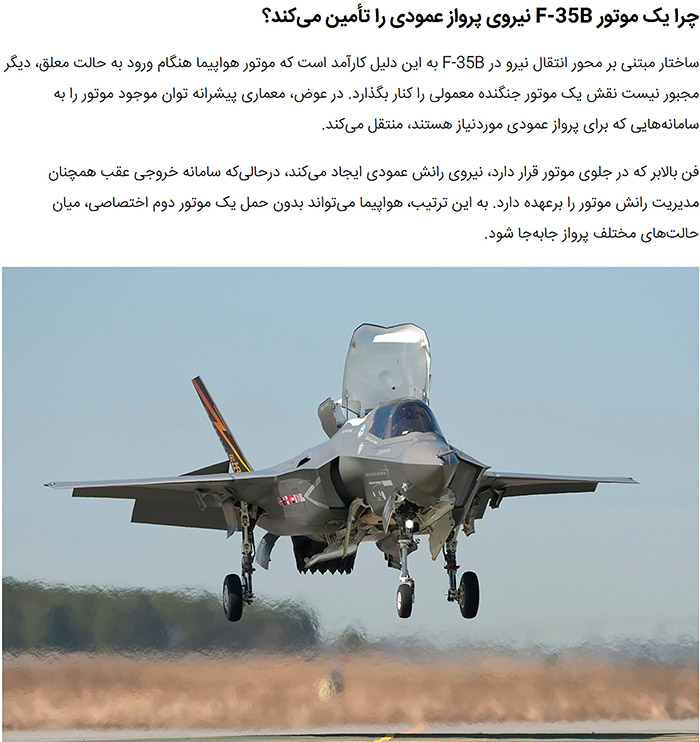
This is critical because a hovering aircraft does not have the same aerodynamic stability available during normal forward flight. The F-35B therefore has to coordinate propulsion, flight controls, and aerodynamic surfaces with extraordinary precision.
The result is a propulsion system in which the engine is only one part of a much larger mechanical and aerodynamic architecture.
The Three-Bearing Swivel Nozzle
One of the most recognizable components of the F-35B propulsion system is its rear exhaust nozzle.
In conventional jet aircraft, the engine’s exhaust nozzle points rearward. Its primary purpose is to accelerate the exhaust gases in a direction that produces forward thrust.
The F-35B requires something more flexible.
Its three-bearing swivel module allows the rear nozzle to rotate downward by approximately 95 degrees. During STOVL operations, this redirects engine exhaust beneath the aircraft.
The nozzle therefore changes the direction of the engine’s thrust depending on the aircraft’s flight regime.
This system has to operate under extreme temperatures and mechanical loads. The nozzle is exposed to very hot exhaust gases while simultaneously being required to move through a substantial range of motion.
Its operation must also be coordinated with the lift fan.
If the rear nozzle produces too much or too little thrust relative to the lift fan, the aircraft’s balance and attitude can change. The flight-control system must therefore continuously manage the relationship between these sources of lift.
This illustrates why the F-35B cannot be understood simply as a conventional F-35 with a modified engine nozzle.